I left behind the stability (or the illusion of it) and societal expectations by quitting my job and moving to a place where I don’t know anyone. I’ve created a life where I decide for myself where I go, what I do, and with whom—without being managed and without any hidden agendas. I also want to try getting back to basics.
However, the basics of what?
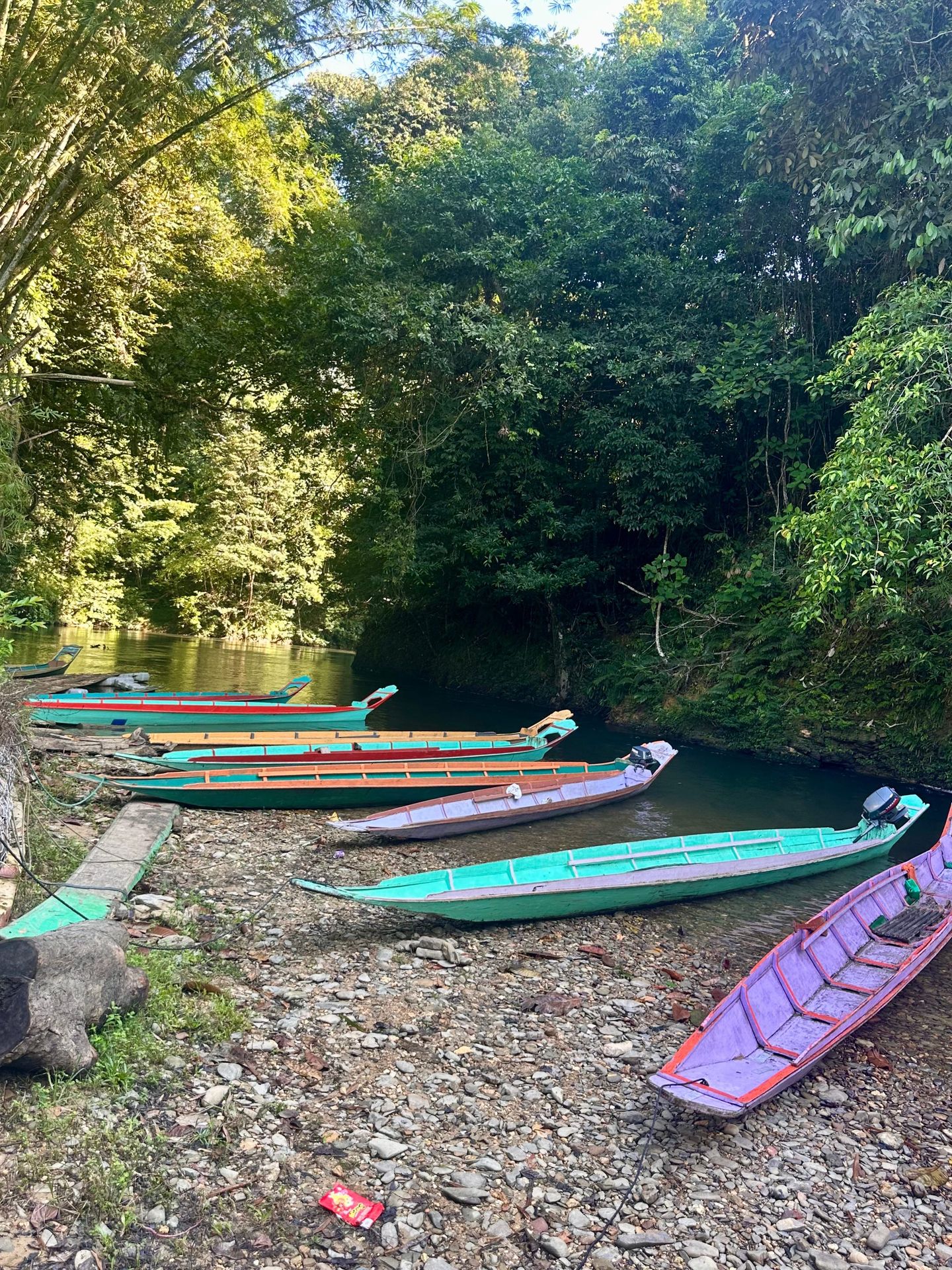
I was invited to stay with the family of a colleague of the guy with the dark eyes in a small village called Nanga Sumpa, in Lubok Antu, which borders the crossing into Kalimantan, Indonesia. The village is quite remote. To get there, we spent over three hours in the car traveling to Batang Ai, where we caught a traditional Sarawakian longboat. It took over two hours by boat to reach the village. What started as a vast, massive expanse of water shifted into a narrower river, giving us a better view of the rainforest it meanders through. The water level has been lower than usual for over a year now, which means we have to transfer to a different boat about half an hour before arriving at the village.
According to a family member, this is due to the Batang Ai dam.
Switching boats is quite an adventure, as we have to scramble over rocks to reach the higher ledge. I understand that in the past, there were no manual outboard motors attached to the boats and everything was done with paddles. I’m glad life has been made easier for the locals, since most supplies have to be bought on the mainland. About 200 people live in the village; they have their own chickens and grow their own vegetables. Fish is caught from the river, and they hunt for wild boar.
And then we reached the kampung.
From the very first minute, I am warmly welcomed and feel right at home. The father of the house tells me that I can treat the place as my own. Normally, this would make me feel self-conscious, but for some reason, I have no trouble with it here. Since we are celebrating Gawai—the end of the harvest season—the rest of the family is also visiting, and there are more than 25 people staying in the house. An estimate, and it took me at least two days to remember a half of the names.
There are six bedrooms in the house, but everyone sleeps wherever they want: on the floor in the living room or next to the kitchen. Children play games on their phones, a group of men sits outside drinking beer, and most of the women are in the kitchen. As soon as breakfast is done, they are already working on lunch, and the same goes for dinner and evening tea. Everything here seems to flow effortlessly, and the family members are exceptionally warm-hearted.
That is certainly the reason why I feel so at home.
I am truly out of my comfort zone here because I have let go of my daily routine—waking up, making my own food, going to the gym, and deciding for myself what I eat and what I do. Now, I eat whatever is served, and I bathe in the river that provides the house with its running water. Before traveling here, I read a lot about the crocodiles in Sarawak and the number of people who have been attacked by them. Because of that, I was hesitant to swim in the river. However, L.—the person who breathed new life into my love life two months ago—told me that crocodiles don’t swim in this area since it’s a mountainous area.
I take him at his word.
The river’s current is quite strong at times, and if you aren’t strong enough, you’ll be swept right back to where the journey began. The water is cold when you first step in, but you get used to it quickly. People bring their shampoo and body wash; parents bring their children, who swim and shower naked in the river. The people here live together with nature in a very special way. They treat her with respect and make use of her resources without damaging them. There are a number of stray dogs roaming the village for protection and to help with hunting. They aren’t the friendliest dogs, so I feel anxious when I see them in the distance or walk past them.
I’ve learned to especially avoid running and to just act as if nothing is wrong.
When we go to shower in the river on the second day, I stub my toe against a large stone as I go underwater to wash the shampoo out of my hair. I also lose a flip-flop in the process, which is quickly carried away by the current. At first, I feel a little pain, but over the following days, my toe turns blue with black edges. I put ice on the toe with ice given to me by the family, and I manage to get through the day reasonably well.
During the day we sleep, I read and write, get to know new people, and we go to the longhouse in the village to celebrate the first day of Gawai. Lots of dancing, drinking, and food. People here know how to be hospitable and how to throw a party. That evening, we visit at least three different houses, where even more drinks and food are served. Traditional Iban single-headed hand drum (Ketebung) are played in one of the houses. I can no longer recall what time it was, but I know that we eventually made it back to our house and that I fell asleep in the living room.
I learn more about the people. Their stories. Their lives.
The house where I am staying is surrounded by greenery, and the windows are always open. Stories about snakes and giant spiders crawling inside kept playing in my head, and those thoughts were triggered even more when we lay in bed. Apart from geckos, however, I haven’t seen anything. The electricity comes from a generator and solar panels. However, the electricity is minimized during the day, which means there is no fan and phones cannot be charged. I left my iPad at home and spend less time on my phone. I take more time to get to know people, without my social battery being drained too much.
When we walk through the village, beer is offered as standard. Or tuak. Or whisky. Because of this, I’ve become more cautious about going outside, especially after the first two days. The guy with the dark eyes' energy recharges me; I like being with him. On the last night, we talk for a long time about everything and nothing, and I realize that I might actually be falling in love. Out of nowhere, I start kissing him, after which we continue our conversations until he indicates he wants to sleep. I sleep less than two hours that night before we are woken up by the alarm to get ready for the journey back.
The river is ready to take us back. Back home.