Hidden in a small alley in the heart of Kuching, an 80-year-old coffee shop quietly thrives as a beloved breakfast spot for locals and travelers alike. Run by husband and wife, the shop has withstood the test of time, evolving from a humble charcoal kettle setup into a timeless space that offers a taste of Sarawak’s living history. For Mr. Richard Chong, born and raised in Kuching, the coffee shop is more than a business; it is a way of life that blends heritage, family, and community.
When I arrive at the shop, Mr. Chong sits at his usual spot, in front of the kitchen, facing Lorong Kai Joo.
The shop’s legacy began with his father-in-law, who laid the foundation.
Fifty years ago, his father-in-law passed the reins to his daughter. “In the early days, we used charcoal to boil the water,” he recalls, pointing toward the setup now in place. “Now, of course, we use gas.” Over the years, the business has seen the neighborhood evolve dramatically. What was once a street with opium dens has become a street with many local coffee shops and restaurants.

His daily routine reflects an enduring dedication to both his shop and his family. He wakes each morning at 3:30 a.m., showers, buys bread, and arrives at the shop by 5:00 a.m. to prepare for his first customers. “My day starts before sunrise,” he says. “Some people come as early as six for their coffee and kolo mee.” Madam Tan (Richard’s wife) joins a little later in the morning, often dropped off by their daughter on her way to work. Together, they run the shop without extra staff; brewing every cup and preparing every plate themselves.
Breakfast is the heart of the menu, featuring local classics such as kaya toast, half-boiled eggs, and kolo mee. Yet the undisputed star is the “opium coffee”, aka butter coffee, a nostalgic specialty that keeps customers coming back. “A customer actually suggested calling it opium coffee,” Mr. Chong says. In keeping with tradition, takeaway drinks are served in recycled metal condensed milk tins rather than plastic bags or cups, a choice that is both sustainable and steeped in history.
“Even the doctor said the tin is better than plastic,” he laughs, holding up a well-worn blueish coloured tin.
Richard actually aspired to become a lawyer. He applied to study law in England and was accepted; however, he didn’t go and finished his studies at Sunny Hill school in Kuching. Being the eldest in his family, with eleven siblings, he had to take care of the family. “That’s how things go in a Chinese family,” he says.
“As the eldest, you have to take care of the younger ones.”
I look around the shop. It feels like time stood still here. Cracks and spots on the grey concrete wall, old photos in a red glass cupboard, a giant refrigerator somehow out of place, yet fitting right in this space, pieces of articles from newspapers and memories are stuck on the wall. Its feels like a living room that takes you through the history of this couple’s life.
Madam Tan sits at the table next to us eating her soup. When I ask if I can see how the butter coffee is prepared, she gets up and walks to the small, open kitchen.
“I will do it now, because I eat slow” she says.
I follow her. She takes a cup, fills it with hot water to preheat the cup, and empties it. From there, she uses a coffee sock, filled with coffee grounds, to pour boiling water into the cup. She then adds condensed milk and a pat of butter on the surface of the coffee as a final touch.
She places the cup at our table, a bit of coffee spilled on the saucer. I take a sip. The combination of the strong, thick coffee and the butter gives me a kick; widening my eyes. This will definitely give you the perfect boost to start the day.
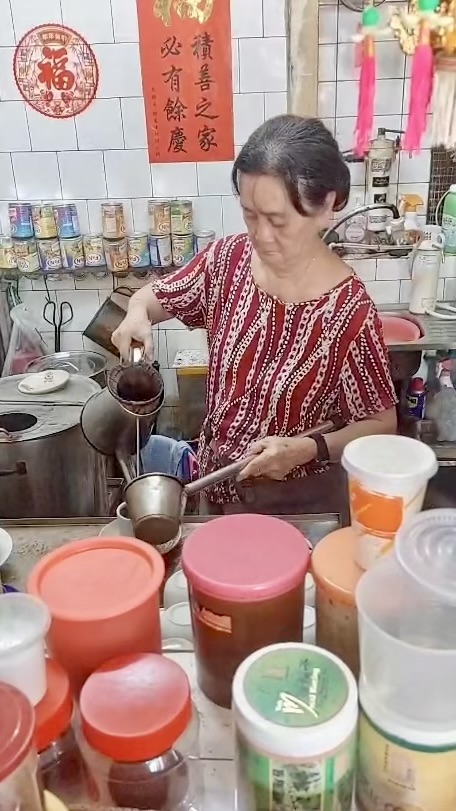
Over the decades, the shop has played host to an ever-changing mix of customers. Travelers from Japan, China, Vietnam, and West Malaysia have all found their way to this shop, often thanks to word of mouth and tourist guides. Customers return, drawn to the authenticity and timeless charm that is rare in today’s fast-paced world.
“Locals come back because they know what they can get here,” he says with quiet pride.
Despite the rise of new coffee shops in the area, they have never felt pressured to compete. By running the shop themselves, they avoid the complications of managing staff and maintain the freedom to close when needed. Sundays are their designated day off, even though they could earn more on that day since it’s the busiest day.
“One day a week, we just rest,” he explains.
Reflecting on a life rooted in Kuching, Richard expresses deep pride in his Sarawakian identity. He praises the peacefulness of the state, the supportive local government, and the sense of community that sustains businesses like his.
“Sarawak is peaceful, and people here know each other,” he says softly. “That is something to be proud of.”
As we come to the end of our conversation, I ask him about the origin of the shop’s name, Hiap Yak Tea Shop, since it is more famous for coffee. He tells me that in the old days, most shops like this were simply referred to as “tea shops.”
Even after half a century of hard work balancing the shop alongside a career at a law firm where he spent decades of his career, retirement is not a priority. “If I can walk, I walk,” he says. “Somehow this is already semi-retirement as we close the shop around 3 p.m.”
The shop is as much a part of his life as the city itself.
Credits of Madam Tan Still/ Photo: Georgette Tan
This interview is in partnership with Dear Sarawak. We are actively looking for local Sarawakians eager to share their stories. If you have a unique story to tell—or know someone who does—we would love to connect!
borneodavid@outlook.com