I hold the roomcard against the black section of the door, below the latch. After a green flashing light has appeared with an accompanying beep, I push against the door and walk in. I put my dark blue trolley against the wall on the right-hand side of the room and take off my shoes. I’m so used now to taking off my shoes when going inside somewhere. I explore the room and open the sheer curtains to get a better view of the life that is lived on the other side of the window.
In the bathroom, I turn on the tap and splash cold water in my face. In my head I’m still thinking about the flight. I take off my T-shirt and wash my armpits with a small white cloth next to the sink. After I have dried my armpits, I take a clean shirt out of my suitcase. The sunscreen is in my backpack. I take the tube out and put a large amount on my left hand, then I rub both hands together and bring them to my face to apply it.
“This room is not bad. It has all the basics,” I say out loud while I look around.
After making my backpack lighter by taking out my laptop and loose toiletries, I sling it on my back and walk out of the room. The door closes with a bang. Before I reach the elevator, I recall it might be wise to protect myself from mosquitoes. I had read somewhere that there are many mosquitoes along the river. I walk back and as soon as I enter my room, I hurry to my bed, where an orange mini can lies between the toothpaste and aftershave. I spray the mosquito repellent on my bare arms and on my clothes, then I put the half-empty can in my backpack and walk out again.
From the fourth floor, I take the elevator down, pass the reception on the ground floor, and head outside. I put on my sunglasses in front of the entrance of the hotel. The heat of the sun feels like a burning hug. Opposite the hotel is the Mukah Clock Tower, locally known as Menara Jam Mukah, which stands in the middle of a roundabout. The tower, which was completed in 2002-2003, has an Islamic architectural style inspired by a traditional minaret.
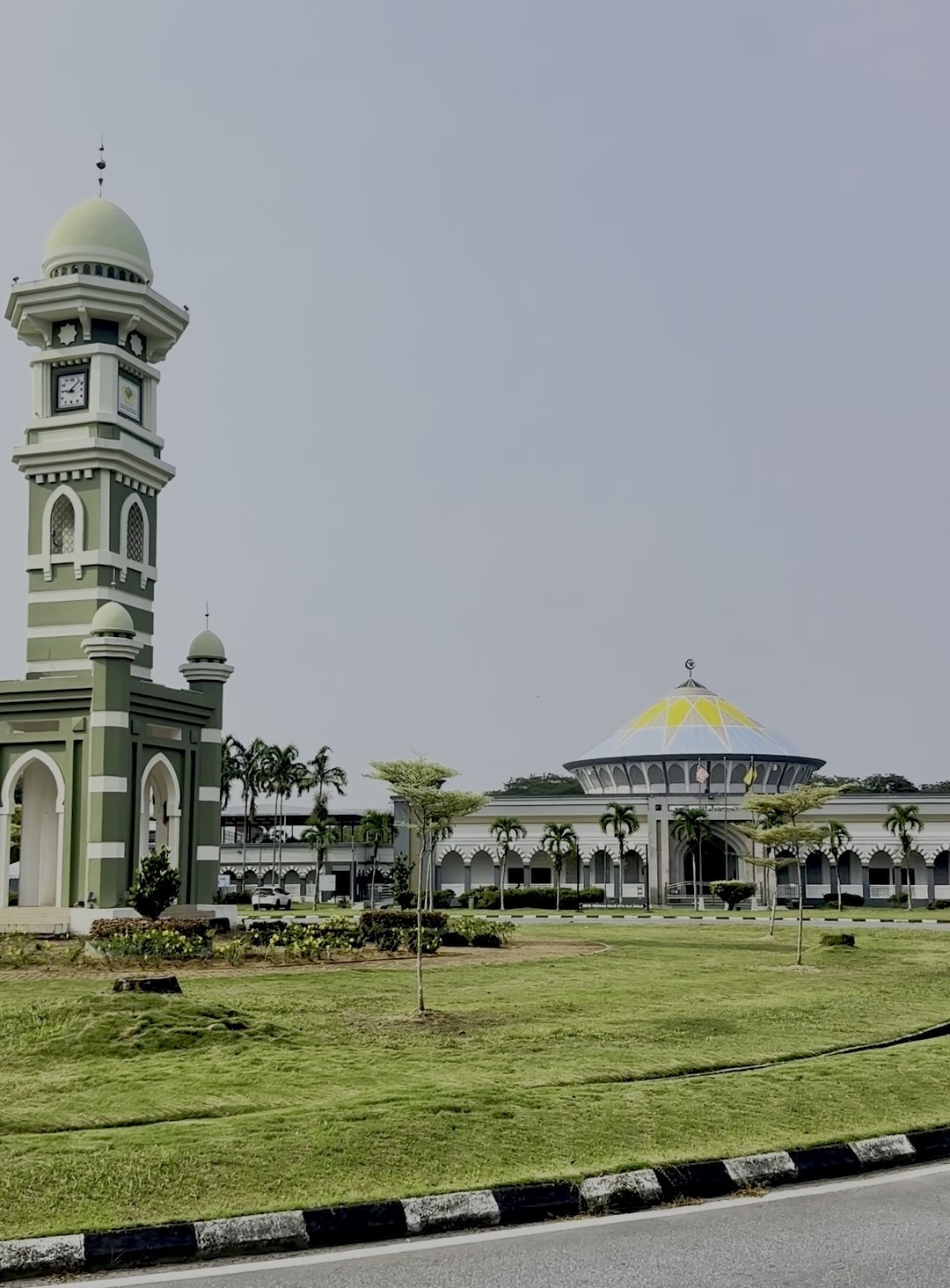
Speaking of mosques: behind the clock tower I see the Setia Raja mosque, the largest in the Mukah district. With an area of 2,900 square meters, this is the central place for Muslims in Mukah. The architecture is a mix of indigenous identity and classical Islamic influences. What immediately catches my eye is the cone-shaped roof, which is called the terendak dome, inspired by the terendak, the traditional sun hat of the Melanau people worn mainly by women.
I take some pictures and decide to turn left to walk towards the waterfront.
I pass by concrete blocks with shops, small businesses, restaurants and clinics. I decide to go into a supermarket to buy water and cookies. I crave something sweet. The people here are friendly and every now and then I get a shy look, or a “hi Sir, where are you from”. I haven’t seen any other foreigners in this small town. I pay for my goods and see an “I heart Mukah” sign in the distance, behind which is the fish market. On the left I pass market tents, which remind me of food stalls you see at night markets.
A red fish stands in the middle of the road, opposite the fish market, also called Pasar Tani Mukah. It’s a red sea bass. The smell of seawater greets me. The atmosphere is friendly and peaceful. People drink kopi at the café called Gerai Kopi Market Dana, which is located near the market, and flags of Malaysia and Sarawak hang over colored plastic chairs and tables. Tables are filled with local delicacies such as pulut pandan, tapai and nasi lemak.
I walk through the fish market. Most stalls are already closed, because it is already past noon. One of the sellers advises me to come back in the morning when the fish are brought in. The market is located next to the Gigis River, a side stream of the Batang Mukah River. The river is known for its freshwater giant prawns (udang galah). This probably explains why there is a statue of a giant prawn on the waterfront. Across the river I see colored letters spelling Mukah. The river water is brown and a number of tree trunks are carried away by the current.
As I continue walking, I feel my upper arms tingling.
I rub them a number of times and shake my arms out in a reflex. This helps for a few minutes, but then the tingling starts again.
When I take a last picture of the brick sago factory chimney, a 20-meter-high symbol of the 19th-century sago trade in the region, the tingling on both my forearms becomes more intense. I decide to walk back to the hotel. To distract myself, I search online for more information about the chimney. I read that the chimney was built around 1865 by the Borneo Company Limited (BCL) to process sago starch for export to England. The factory closed in the early 20th century due to plummeting sago market prices and strong competition from local Chinese sago mills. Today, it is officially recognized as a heritage monument from the colonial era.
When I reach my hotel room, I throw off my clothes and jump into the shower. I hope the water makes the tingling sensation go away. Nothing could be further from the truth, as it turns out when I get out of the shower and dry myself. Could it be a mosquito bite? Do I have dengue? I ask myself. I consult my phone to find out where the tingling could come from. Suddenly I think about the mosquito repellent I used. I take the can and read the description. It turns out that it should only be used in rooms to scare away or kill mosquitoes.
The tingling now becomes more intense. It feels like tiny needles are crawling through my arms.
Panic spreads through my body. I decide to go to the nearest clinic which is only a couple of minutes from the hotel. When I enter the clinic, it is packed. The receptionist asks me to register. I write my name, date of birth, phone number, and passport number on a piece of paper and take a seat in the waiting area. A woman with a tudung sits next to me, her face pale. A few boys play games on their phones, an elderly Chinese lady coughs and sneezes at the same time, and on the small LCD TV hanging opposite me, 80s music videos are playing.
“Mister David,” I hear while I’m doomscrolling on my phone. My last name is usually a problem to pronounce. I get up and walk towards the room where the doctor is already waiting for me. “Where are you from?” is the first thing he asks. After some small talk, I explain to him what is going on. I also show him a picture of the mosquito repellent which I sprayed on my arms. He explains to me in detail why I feel tingling and that it should be over by tomorrow morning. If that is not the case, I have to come back and we can do a blood test. We then talk about football, although I don’t know anything about football at all, and I thank him for the reassurance and shake his hand. I walk to the reception. The receptionist gives me a paper card with the doctor’s details. “How much is it?” I ask. “It’s free,” she replies. I look surprised and thank her several times, after which I walk out of the clinic.
Relieved, I return to my room. Once, I’m in bed, my tingling sensation and I both drift off to sleep.
Thank you for reading Borneo Stories! The best adventures aren't done alone. I’m actively seeking collaborators, locals, and partners who want to showcase the authentic beauty of Borneo together. If you have a unique perspective, feedback or a location to share, I'd love to connect.
borneodavid@outlook.com